Beyond the Blue: Interdisciplinary Explorations of Water in Africa
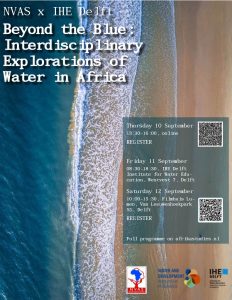
The Nederlandse Vereniging voor Afrika Studies (NVAS), in partnership with the IHE Delft Institute for Water Education, is organising the conference Beyond the Blue: Interdisciplinary Explorations of Water in Africa, taking place in Delft on 11-12 September 2026.
Registration is now open. View the conference programme for session details and scheduling. Participants can join the online webinar on 10 September or attend the in-person conference in Delft on 11-12 September. The registration deadline is extended until 4 September 2026. We look forward to welcome you in Delft!
Thinking with water provides several new orientations for regional studies, including those focusing on the African continent and its global connections. Centering waterscapes surfaces connections, networks, and concerns that open up new thematic orientations and bring a wide range of urgent matters to the fore, ranging from climate change adaptation to endangered cultural narratives. The volatility of climate change is making the presence and absence of water increasingly problematic, leading to floods and droughts, increasing challenges of water management and its politics. Water ecologies are of crucial importance to human life, livelihoods and landscapes, making it critical to bring together different modes of engaging with new (and old) challenges. This calls for a fresh look at water in connection to Africa.
Oceans and waterways have long facilitated contact and exchange, aiding in the spread of language, culture, and religion, but also made possible colonial conquest and formations of empire. Fields like the Black Atlantic or Indian Ocean histories draw on such oceanic connections to contribute to decolonial histories. Recent disruptions of shipping routes, due to the pandemic, environmental changes and spreading conflicts, reveal the importance of marine spaces and security for the maintenance of current economic and political architecture, and its potential for ruptures and re-imaginations. Furthermore, a focus that centers oceans and rivers not only as infrastructures for exchange, but also as lively spaces with their own rhythms and qualities, invites the study of diverse industries and modes of being that involve more-than-human dependencies or extractive activities, such as fisheries or offshore drilling, as well as practices geared towards fostering ocean management, coastal resilience and care for riverine systems. This conference seeks to pay attention to the diverse meanings of water in African societies, cultures, and environments, ranging from rainmaking rituals to riverine trade routes and (oral) poetry related to waterbodies.